


Autism Spectrum Disorder: What Do We Know and Where Do We Go?
Overview
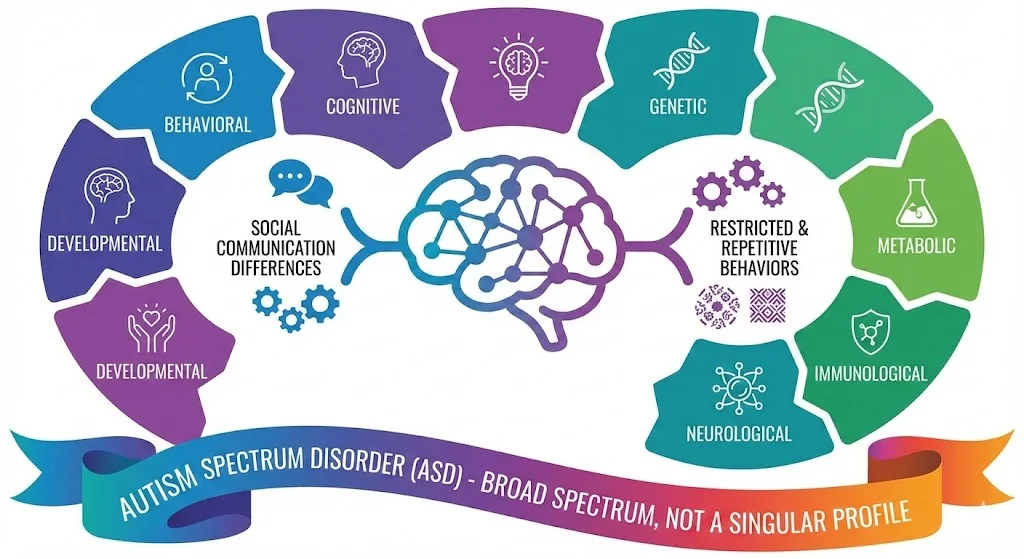
Autism spectrum disorder (ASD) is a multifaceted neurodevelopmental condition that typically presents in early childhood and continues throughout life. Core characteristics include differences in social communication and the presence of restricted or repetitive behaviors. Modern research underscores the significant variability seen across behavioral, cognitive, genetic, metabolic, immunological, neurological, and developmental domains, emphasizing that ASD encompasses a broad spectrum rather than a singular profile.
Behavioral Features
Behavioral presentations of ASD can differ substantially depending on factors such as cognitive functioning, language abilities, age, and sex. Early signs may emerge within the first year of life and include differences in joint attention, sensory processing, or language development. Over time, autistic individuals may maintain consistent traits yet encounter evolving challenges. For instance, some adolescents may attempt to mask or camouflage autistic characteristics in social situations, while adults may experience periods of autistic burnout, reflecting cumulative sensory and social demands. Behavioral patterns in older adults remain an area in need of further research.
Psychological Features
No single psychological pattern defines ASD. Differences in executive functioning—particularly flexibility, working memory, and inhibitory control—are among the most frequently observed characteristics. Variations in Theory of Mind abilities are also documented, though these can be significantly influenced by language proficiency, situational demands, and co-occurring anxiety. Emotional regulation challenges and alexithymia are common and often shape interpersonal interactions. Despite these difficulties, many autistic individuals demonstrate distinct perceptual and analytical strengths, including detail-focused processing and strong systemizing tendencies.
Genetic Features
The genetic landscape of ASD is highly complex. Twin studies estimate heritability between 64% and 91%, and more than 200 genes have been implicated. Genetic contributions include common polygenic variants with modest cumulative effects, rare de novo mutations with strong influence, and copy number variants such as the 16p11.2 deletion. Epigenetic modifications, shaped by environmental exposures, also play a role. Despite advances in identifying genetic contributors, linking specific genetic patterns to behavioral and developmental outcomes remains challenging because of broad variability in expression.
Metabolic Features
A subset of autistic individuals exhibit metabolic differences that may include mitochondrial dysfunction affecting cellular energy processes, increased oxidative stress paired with limited antioxidant capacity, and disruptions in folate and methylation pathways, sometimes associated with folate receptor‑alpha autoantibodies. Alterations in amino acid and lipid metabolism have also been documented. These metabolic profiles may relate to variations in symptom severity, gastrointestinal functioning, fatigue, and cognitive performance. Nevertheless, metabolic differences are not universal, and further research is needed to clarify their clinical implications.
Immunological Features
Immune differences are one of the most consistently replicated findings in ASD research. Neuroinflammation characterized by microglial activation has been observed, along with altered cytokine profiles, including elevated IL‑6 and TNF‑alpha levels. Maternal immune activation during pregnancy is recognized as a significant prenatal risk factor for ASD. In a subset of cases, maternal brain‑reactive autoantibodies have been identified. Gut‑immune interactions—such as increased intestinal permeability and microbiome imbalance—further highlight the complexity of ASD’s biological underpinnings. Ongoing work is needed to determine whether immune differences are causal, adaptive, or secondary phenomena.
Speech and Language Features
Speech and language development among autistic individuals varies widely. Some experience expressive language delays, while others demonstrate atypical prosody, echolalia, or differences in pragmatic communication. Neurobiological studies have documented altered connectivity and reduced hemispheric lateralization in language networks. Importantly, augmentative and alternative communication (AAC) systems have been shown to support language development effectively, providing essential communication pathways for minimally verbal individuals without impeding future speech acquisition.
Brain Connectivity and Neurological Findings
Neuroimaging studies consistently show differences in both structural and functional connectivity in the autistic brain. These include variations in white matter microstructure during early childhood, differences in local and long‑range functional networks, and altered organization of neural hubs involved in communication, cognition, and sensory integration. Rather than indicating a single localized deficit, findings support the view that ASD reflects differences in distributed neural networks that evolve across development and vary with cognitive tasks.
Developmental and Maturational Influences
ASD is shaped by dynamic developmental trajectories influenced by genetics, neurobiology, and environmental exposures. Early brain overgrowth in infancy, reduced hemispheric asymmetry—particularly in language regions—and prenatal factors such as maternal immune activation or metabolic differences have all been associated with ASD. Hormonal transitions during puberty may further influence social, emotional, and cognitive development. Despite increasing research interest, developmental outcomes in older autistic adults remain a significant area of uncertainty.
What Is Known and What Remains Uncertain
Research has clarified several foundational aspects of ASD, including the persistence of early behavioral differences, the presence of executive functioning variability, strong genetic contributions, and distinct metabolic and immune characteristics in subsets of individuals. Alterations in brain connectivity have also been widely documented.
However, several important questions remain. These include understanding the biological relevance of metabolic and immune subtypes, the mechanisms underlying camouflaging and autistic burnout, predictors of varied language trajectories, the potential for biomarkers to assist in diagnosis or treatment planning, and the developmental course of ASD in later adulthood. Addressing these gaps will require coordinated, longitudinal research integrating behavioral, biological, and environmental factors.
Conclusion
Autism spectrum disorder arises from a complex interaction of genetic, metabolic, immunological, neurological, and developmental mechanisms. Although substantial progress has been made in characterizing these factors, many causal pathways remain uncertain. Continued research will improve the precision of diagnostic tools and the effectiveness of individualized interventions—an objective that aligns with Lucentra Care’s commitment to evidence‑based, compassionate care for autistic individuals and their families.
Citation:
Leisman, G., & Melillo, R. (2025). Autism Spectrum Disorder: What Do We Know and Where Do We Go? *Brain Sciences, 15*(9), 1010. https://doi.org/10.3390/brainsci15091010
To learn more about our ABA programs at Lucentra Care, visit our ABA Therapy Services Page.